 |
|
Images of Science
by Sherri
Cooper |
This mud tells a
story. Paleoecology is the textbook.
Sherri's job is to read the story, and
to interpret what the diatom and pollen species indicate about the
environment.
More on
Diatoms. |
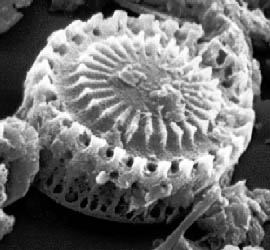 |
 This micro-Coliseum is
actually a diatom called Paralia sulcata.
It lives on the bottom of estuaries and marine environments, and disappears if
the water gets too fresh or silty. This micro-Coliseum is
actually a diatom called Paralia sulcata.
It lives on the bottom of estuaries and marine environments, and disappears if
the water gets too fresh or silty.
|
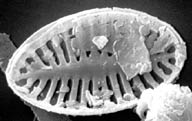 |
Achnanthes delicatula is a common brackish water
species. It is a good indicator of low salinity and warm
temperatures.
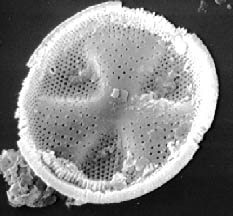
Common in
oceanic plankton, Actinoptychus senarius
likes to catch a ride on other algae. |
 |
 |
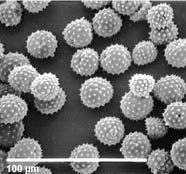 |
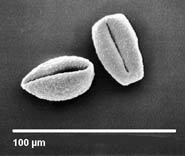
This is what
Ragweed pollen (Ambrosia) looks like. No
wonder it makes your nose itch!
This
Oak pollen (Quercus) is a little less
threatening.
|
The ratio
of Oak to Ragweed pollen changed drastically when Europeans arrived and started
clearing land for agriculture. As the trees were replaced by fields, the amount
of Oak pollen that fell into the water decreased, and the amount of Ragweed
pollen increased. This change is evident when you look at pollen in the
sediments. Because we know the time period when land was cleared, we can tell
the date when that sediment was deposited. Then we can extrapolate other dates
by looking at the density of pollen, and deriving the rate at which the
sediments were deposited.
|
 |
|
|
|